
Why American Mahjong Is Growing in America: Strategy, Ritual, and Community
American Mahjong is growing because it combines three things people are actively looking for: an absorbing strategy game, a repeatable in-person ritual, and a natural reason to build community. Recent event data and reporting show more organized Mahjong gatherings and younger newcomers, but today’s interest is also part of a much longer American history shaped by Chinese American communities, Jewish American women, teachers, clubs, and families.
What does the evidence actually show?
Associated Press reporting published in 2025 described crowded Mahjong pop-ups in San Francisco and cited Eventbrite data showing a 179% increase in U.S. Mahjong events on its platform from 2023 to 2024. Eventbrite has separately highlighted growing interest in tactile, offline activities among younger adults.
That is evidence of increased event activity, not a census of every American player. Many games happen in homes, libraries, clubs, and community organizations and never appear on a ticketing platform. “Rising public participation” is more accurate than a precise national player count.
The growth is also not one single movement. Some newcomers learn American Mahjong with an annual card; others play Hong Kong–style, Riichi, Taiwanese, Filipino, Singaporean, or another regional form. “Mahjong is growing” describes a family of connected revivals, not one universal ruleset.
Strategy makes the game worth returning to
American Mahjong gives beginners a visible destination: a legal 14-tile hand shown on the current card. That reference can make the first lesson feel more concrete. Yet the card does not make the decisions automatic. Players still interpret suit relationships, protect useful pairs, compare candidate hands, pass during the Charleston, decide when to pivot, observe exposures and discards, and manage incomplete information.
This produces a helpful learning curve. A new player can understand the basic turn rhythm—draw, reconsider, discard—before mastering every exception. An experienced player can keep improving because each deal changes the available evidence. The annual card refreshes the set of possible hands without requiring the player to relearn tile recognition and table rhythm from the beginning.
Strategy remains social. A discard affects everyone, and a call changes what the table knows. Those visible consequences create useful conversation after the hand: What did you keep, and when did you change direction?
If you are beginning, use How to Play American Mahjong: A Calm First-Game Guide to learn the rhythm without reproducing or memorizing any annual card hands.
Ritual turns a game into a standing invitation
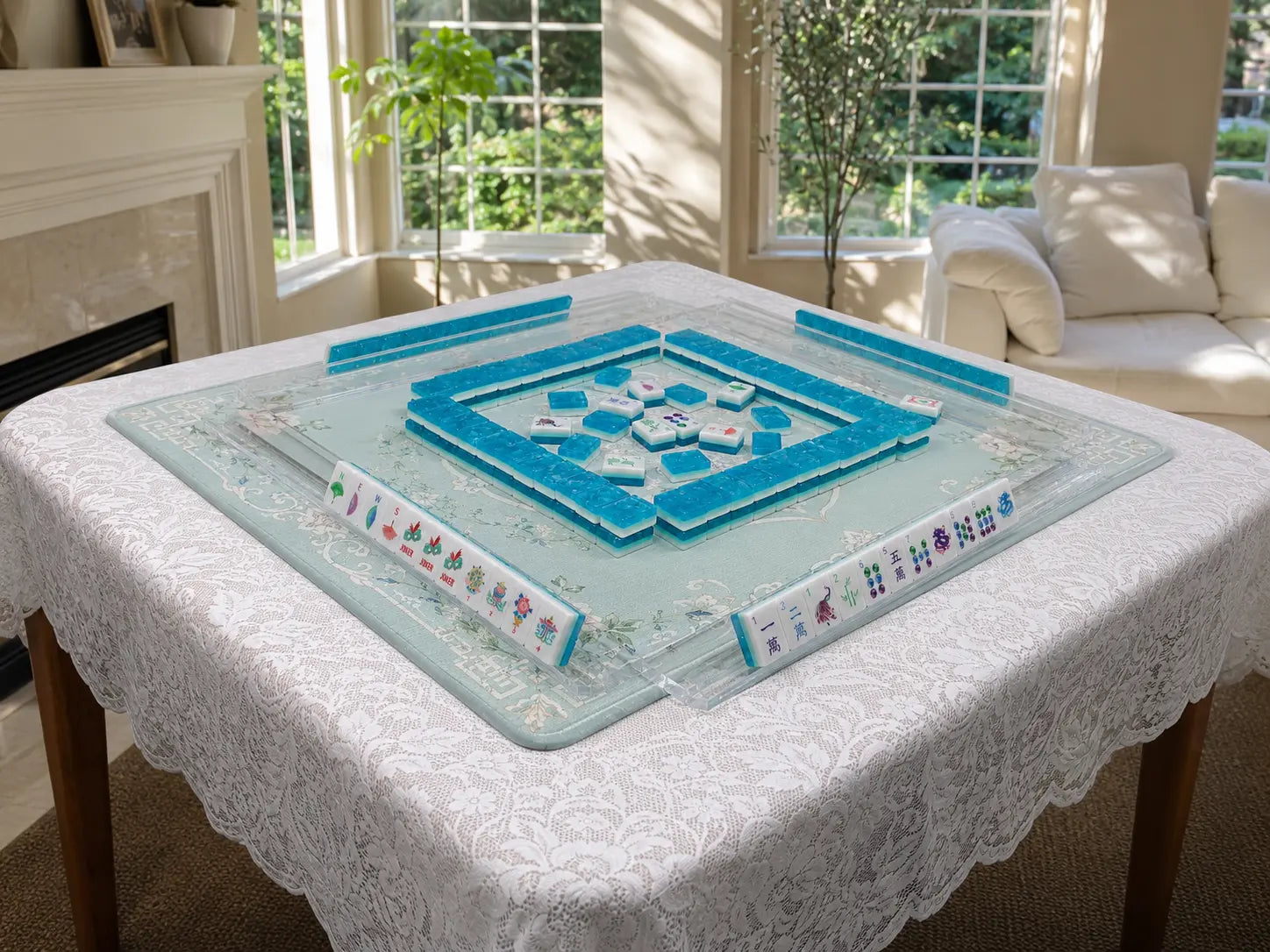
Mahjong has a physical sequence that is easy to recognize: open the case, mix the tiles, build four walls, set the racks, deal, pass, draw, and discard. The sound and movement distinguish the gathering from another hour spent looking at a screen.
The ritual also solves a practical social problem: people do not have to invent a new activity every time they meet. A weekly or monthly table already has a shape, a start, and a shared vocabulary. Food, music, décor, and scoring can be simple or elaborate, but the game provides the reason to put the next date on the calendar.
Ritual should not become rigidity. Welcoming tables explain the house rules, make space for questions, and avoid using speed as a test of belonging. The strongest tradition is the one people understand well enough to join and enjoy.
Community is not a new feature of Mahjong
Historian Annelise Heinz has documented Mahjong’s movement from China to the United States and its role in American life across the twentieth century. Her research shows that the game helped create social spaces in Chinese American and Jewish American communities, while also becoming entangled with commerce, gender, migration, and stereotypes.
That history matters because the current boom did not invent Mahjong’s social power. Long-running home games and community tables sustained it across generations. For some players today, learning is a way to reconnect with family memory or cultural heritage. For others, it is a new hobby introduced by a friend. Both experiences can coexist, provided newcomers approach the game with curiosity rather than treating its history as decorative branding.
Different Mahjong traditions are related but not interchangeable. Ask which version a host teaches, and avoid describing American Mahjong as the original or universal form. For a high-level comparison, read Mahjong Around the World: Seven Ways the Game Changes.
Why the format works for real-world friendship
| Quality | What happens at the table | How a host can support it |
|---|---|---|
| Shared focus | Four players attend to the same evolving game | Keep phones optional and references within reach |
| Conversation | Turns create natural pauses for talk | Set a relaxed pace and allow questions |
| Continuity | The table works well as a recurring gathering | Choose the next date before people leave |
| Mixed experience | Beginners can learn while experienced players refine decisions | Agree on coaching and take-back rules before the deal |
| Tactile play | Tiles, walls, racks, and passing keep hands involved | Provide enough space, light, and comfortable seating |
The beginner experience is easier to find
Classes, public open-play sessions, social clubs, online explainers, and beginner nights have made it easier to find a first table. The AP’s reporting on large pop-up events is one visible example; smaller library and home lessons are just as important.
A good first lesson names the ruleset, explains the goal, lets players handle the tiles, and teaches concepts when needed. Hosts can support healthy growth by crediting their rules and teachers, distinguishing among variants, using authorized materials, and setting a welcoming standard. See Mahjong Etiquette for Beginners: Make Every Seat Feel Welcome.
What American Mahjong is—and is not—promising
Mahjong can provide challenge, pleasure, and a structure for gathering. It should not be sold as a guaranteed treatment for loneliness, memory loss, or any medical condition. Research on games and cognition is context-dependent, and a pleasant table is not health care.
It is also not automatically inclusive simply because four chairs are present. Accessibility, cost, teaching style, transportation, language, and the behavior of experienced players all shape who can participate. Growth becomes meaningful when new attention supports patient teaching, respectful history, and lasting local relationships—not only attractive photographs.
A practical checklist for joining the growth thoughtfully
- Ask which Mahjong variant and house rules the table uses.
- Use the current authorized card if the group plays an annual-card format.
- Learn the draw-and-discard rhythm before chasing speed.
- Confirm whether the gathering is a lesson, social play, or competitive play.
- Ask before coaching another player’s rack.
- Make your discards and calls clear enough for everyone to follow.
- Read about the game’s Chinese origins and varied American histories.
- Invite people back; community is built through repetition.
Frequently asked questions
Is American Mahjong really becoming more popular?
Public evidence points to increased interest: Eventbrite reported a 179% rise in U.S. Mahjong events on its platform from 2023 to 2024, and news coverage has documented large newcomer-focused gatherings. That does not establish a complete national player count, so “growing public participation” is the careful conclusion.
Why do people find American Mahjong engaging?
It combines a clear turn rhythm with layered decisions about candidate hands, passing, tile availability, calls, exposures, and pivots. The physical tiles and four-player format also make the strategy part of an in-person social experience.
Is American Mahjong the same as traditional Chinese Mahjong?
No. They belong to the same broad game family, but American Mahjong commonly uses an annual card, Jokers, racks, and the Charleston. Chinese regional variants have their own hand structures, scoring, tile mixes, and customs.
Do I need to know someone who already plays?
No. Look for a clearly labeled beginner class, library group, community event, or instructor. Before registering, confirm the variant, what equipment is provided, and whether the session includes guided practice.
Does playing Mahjong improve brain health?
Mahjong requires attention, recognition, and decision-making, but no casual game should be presented as a guaranteed medical intervention. Play because it is challenging and social; consult qualified health professionals for health concerns.
Sources and further reading
- Associated Press — Mahjong nights draw young crowds to San Francisco bars and restaurants
- Eventbrite — Platform data on the growth of Mahjong and other offline events
- Stanford Department of History — Mahjong’s role in modern American community and culture
- Oxford Academic — Mahjong: A Chinese Game and the Making of Modern American Culture by Annelise Heinz
- American Mah Jongg Association — Beginner’s Guide to American Mah Jongg
Four Seats is not affiliated with or endorsed by the National Mah Jongg League. No annual card hands are reproduced here.






Leave a comment
This site is protected by hCaptcha and the hCaptcha Privacy Policy and Terms of Service apply.