
Article: How to Play American Mahjong: A Calm First-Game Guide
How to Play American Mahjong: A Calm First-Game Guide
American Mahjong is a draw-and-discard game in which four players each build one exact 14-tile hand shown on the current annual card. For a first game, focus on the rhythm—choose a possible line, exchange tiles in the Charleston, then draw one and discard one. You do not need to memorize the whole card before you sit down.
This guide describes the widely played National Mah Jongg League style. Keep the current card and the current official rulebook beside you when a table question needs a ruling. Four Seats is an independent retailer and learning resource; it is not affiliated with or endorsed by the National Mah Jongg League.
The game in one minute
- Build four walls and deal 13 tiles to each player; East begins with 14.
- Use the Charleston to pass unwanted tiles and begin shaping a hand.
- East discards first. Play then moves counterclockwise.
- On a normal turn, draw one tile and discard one tile.
- When permitted, call a discard to complete a grouping and expose it.
- Win by matching one complete 14-tile line on the current card exactly.
Terms worth knowing before the first deal
| Term | Plain-English meaning |
|---|---|
| Pair | Two identical tiles. |
| Pung | Three identical tiles. |
| Kong | Four identical tiles. |
| Quint / sextet | Five or six identical tiles; these groupings require Jokers because only four natural copies exist. |
| Exposure | A completed grouping placed face-up on top of the rack after a legal call. |
| Natural tile | The actual tile named by the hand, rather than a Joker. |
| Dead hand | A hand that is no longer eligible to win because of a rules error or an impossible exposed structure. |
Step 1: Set up the table
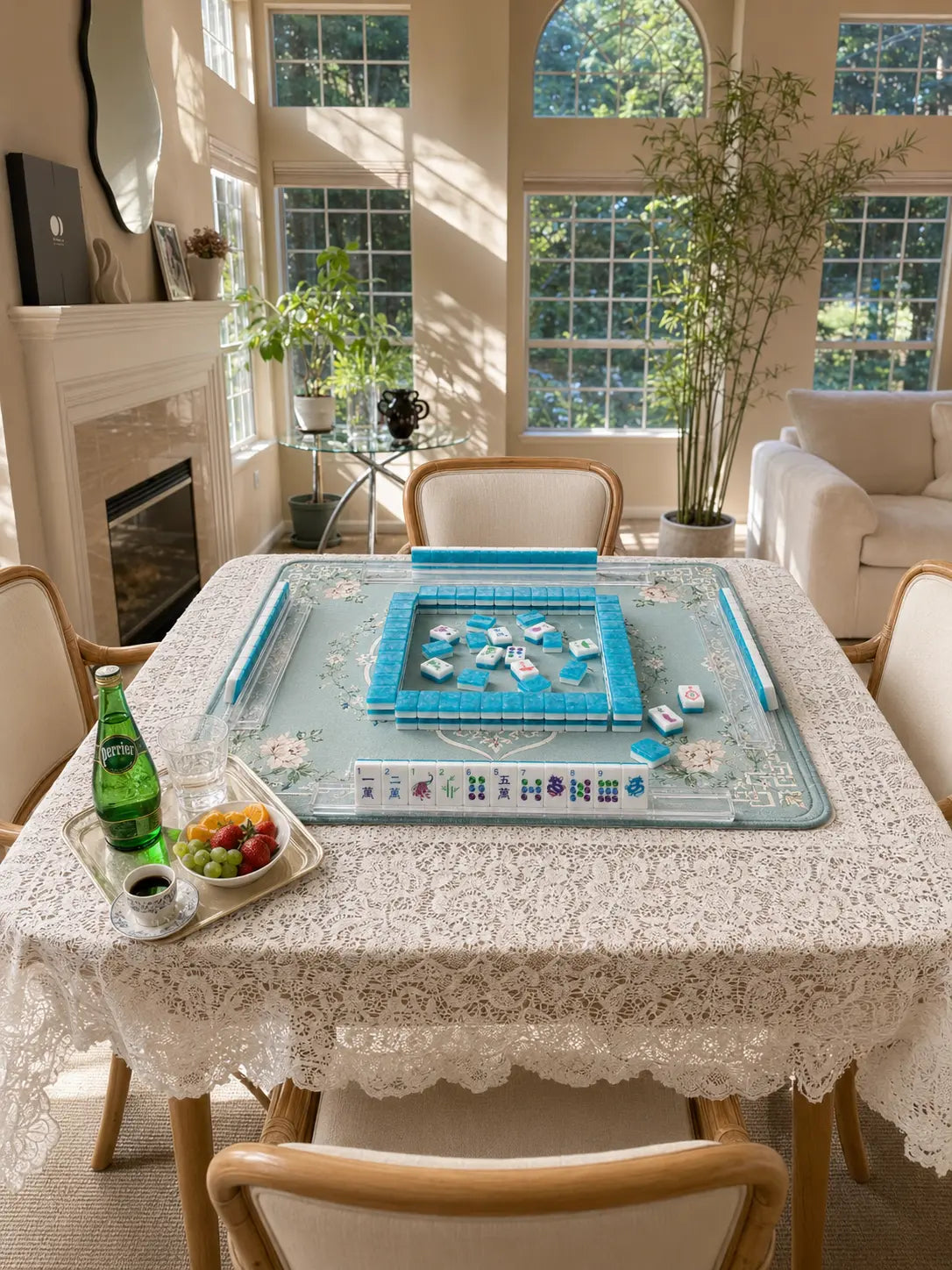
Use 152 playable tiles: 108 suited tiles, 16 Winds, 12 Dragons, eight Flowers and eight Jokers. Each player builds a wall 19 tiles long and two tiles high, then the four walls are pushed together into a square. Choose East using your table’s usual dice procedure.
Deal until East has 14 tiles and every other player has 13. Place tiles on the sloped part of the rack so only you can see them. Sort by suit and number; keep Winds, Dragons, Flowers and Jokers together at one side while you compare possibilities on the card.
Step 2: Choose a direction, not a perfect hand
Scan the card for two or three lines that fit the strength of your starting tiles. Look first for repeated numbers, Flowers, or Winds you already hold. Check whether each line is marked exposed or concealed. You are choosing a working plan, not making a promise: changing hands is a normal part of good play.
If the card still feels like a wall of symbols, use our calm guide to reading the American Mahjong card before your game.
Step 3: Complete the Charleston
The Charleston is the structured exchange before normal play. In the first Charleston, every player passes three tiles right, three across and three left. A second Charleston—left, across, right—continues only under the current rules and your table’s agreement, followed by the permitted courtesy pass.
Do not pass Jokers. Avoid passing a pair unless you have a clear reason. On the final pass of a Charleston, current rules allow a limited blind pass: use tiles received from the prior player without looking at them, following the official procedure. For a first teaching game, let one experienced player calmly announce every pass.
Step 4: Draw one, discard one
East begins by discarding one of the 14 tiles. The next player draws from the wall, studies a 14-tile hand, then discards face-up and clearly names the tile. That draw–decide–discard rhythm continues counterclockwise.
A useful beginner routine is:
- Bring the drawn tile fully to your rack.
- Recheck your selected card line.
- Keep tiles that serve more than one candidate hand.
- Discard clearly and wait until the next player touches the wall.
Step 5: Know when a discard may be called
You may call the most recent discard when it completes a legal grouping of three or more for a hand that permits exposure. Say the tile name, take it, and place the full grouping face-up on top of your rack. You then discard, and play continues from you. Calling changes turn order, so pause long enough for every player to respond.
You generally may not call a discard merely to complete a single or pair. The important exception is a discard that completes Mah Jongg. A hand marked concealed may not make ordinary exposures; it can call only the winning tile under the current rules. A discarded Joker cannot be called.
Joker basics without the confusion
- Jokers may substitute in groupings of three or more: pungs, kongs, quints and sextets.
- Jokers may not represent a single or either tile in a pair.
- Jokers are never passed during the Charleston.
- On your turn, an exact natural tile may be exchanged for a Joker in a valid exposure, following the official sequence.
- If a Joker is discarded, it is dead and cannot be claimed.
How a hand becomes dead
Common causes include holding an incorrect number of tiles, making an exposure that cannot match a card line, exposing while pursuing a concealed hand, calling a tile for an illegal grouping, or making a Joker placement that the rules do not allow. Do not diagnose another player’s hand casually. If a question arises, stop, check the current card and rulebook, and let the table resolve it without embarrassment.
Your first-game checklist
- Current annual card within easy reach
- Exactly 152 playable tiles, including eight Jokers
- Four racks that fit the tiles
- One teacher announcing Charleston and turn order
- Permission to play open-handed for the first round
- A single goal: finish each turn with the correct tile count
Still gathering the table? See what you need now—and what can wait. To build recognition between games, try these short solo practice drills.
Frequently asked questions
How many tiles should I have?
Most of the time you hold 13 tiles. During your turn, after drawing or calling, you temporarily have 14 and must discard back to 13. A complete Mah Jongg hand contains 14 tiles.
Do I have to decide on one hand during the Charleston?
No. Keep two or three compatible options while the passes develop. Commit only when your tiles and the visible discards make one route clearly stronger.
Can I call a discard for a pair?
Not during ordinary play. You may call a discard that completes a pair only when that tile completes Mah Jongg, subject to the current rules.
Can a Joker be used for a Flower?
Only when the Flower is part of a grouping of three or more. A Joker cannot replace a Flower shown as a single or in a pair.
What should a beginner do after making a mistake?
Pause and verify the rule. In a teaching game, explain the correction and keep the table welcoming. Formal penalties can wait until everyone has agreed to play formally.





Leave a comment
This site is protected by hCaptcha and the hCaptcha Privacy Policy and Terms of Service apply.